
In continuing professional development (CPD) for healthcare professionals, credible sourcing is not a formality. It is central to educational integrity. The sources used to support needs assessment, learning objective, clinical recommendation, assessment items or outcomes claim shape the quality and defensibility of the educational activity.
Large language models (LLMs) are changing how CPD teams draft, review and validate content. They can help identify themes, summarize topics, generate outlines and suggest references. They can also produce incomplete, outdated, misapplied or fabricated citations. A 2026 audit of 2.5 million biomedical papers identified 4,046 fabricated references across 2,810 papers.¹ The issue is not whether AI can be useful; it can. The issue is whether CPD professionals use disciplined processes to assess credibility, including potential bias, and independently verify anything AI supplies.
This article offers a practical framework in two parts: first, best practices for selecting credible sources; second, safeguards for using and vetting LLM-generated references.
Part I: Best Practices for Selecting Credible Sources
Selecting credible sources begins before content is written. The first question is not “What citation can I find?” but “What claim am I trying to support?” A source should be selected because it is authoritative, methodologically sound, transparent, relevant, current and appropriate for the claim being made.
Not all claims require the same evidence. A clinical recommendation requires different support than a statement about adult learning, learner engagement or evaluation design. For clinical content, stronger sources include current clinical practice guidelines, specialty society consensus statements, systematic reviews, meta-analyses, landmark trials, regulatory communications and high-quality original research. For CPD design, appropriate sources may include peer-reviewed literature on adult learning theory, instructional design, assessment, evaluation, implementation of science or outcomes methodology. For accreditation, maintenance of certification or regulatory requirements, primary source documents, such as the ACCME Standards for Integrity and Independence in Accredited Continuing Education, should be used whenever possible. ²
A practical test is: What is this source being asked to prove? If the source does not directly support the statement, it should not be used.
Practical Source-to-Claim Guide
|
Claim type
|
Stronger source choices
|
Use cautiously
|
|
Clinical recommendation
|
Guidelines; consensus statements; systematic reviews; landmark trials
|
News article; blog; outdated review
|
|
Accreditation or compliance requirement
|
Primary accreditor standard or official guidance
|
Vendor summary; informal checklist
|
|
CPD design or evaluation claim
|
Peer-reviewed education or outcomes literature
|
Anecdote; vendor white paper
|
|
AI or reference verification
|
Publisher site; PubMed; Crossref; institutional library
|
LLM-generated citation without verification
|
Use the strongest available source that directly supports the claim, preferably the original guideline, standard or study. Treat abstracts, commentaries, news reports and other secondary summaries as leads unless they are the only available evidence.
Credibility also depends on methodology. For clinical literature, reviewers should consider study design, sample size, population, intervention or exposure, comparator, outcomes, statistical methods, limitations and applicability. For educational literature, reviewers should consider the theoretical framework, learner population, instructional intervention, evaluation approach, outcomes level, data collection methods and limitations. CPD professionals do not need to be biostatisticians to recognize when evidence is being overextended. A small single-site educational intervention may generate ideas but may not support broad claims about effectiveness. A satisfaction survey may demonstrate learner reaction but not competence, performance or patient outcomes.
Reliable sources should disclose who created the work, how it was funded and whether authors had relevant conflicts of interest. CPD reviewers should consider sponsor or author conflicts, selective publication or reporting, limitations in population representation and algorithmic or retrieval bias that may influence which evidence an AI tool surfaces. Industry involvement does not automatically invalidate a source, but it requires careful review of whether the funding source influenced the research question, design, interpretation, writing or publication and whether independent evidence supports the same conclusion.
Relevance is equally important. A high-quality source may still be a poor fit if it does not apply to the learner, discipline, practice environment, geography, patient population or educational purpose. In CPD, source relevance should be tied to the identified professional practice gap.
Currency should be assessed in context. For rapidly changing clinical and technology topics, teams may begin with evidence published within the past three to five years and conduct a targeted search of the past 12 to 24 months, while retaining older landmark sources when current guidance continues to support them. Foundational sources in adult learning or evaluation may remain useful longer. AI-generated output requires an additional currency check because a model may have a knowledge cutoff or may lack live retrieval. Teams should independently confirm whether guidelines have been updated, major trials or safety communications have changed practice and cited therapies or technologies remain in use.
For higher-stakes CPD content, document the source review in a simple Source Review Record. Capture:
- Source and stable identifier or URL
- Claim supported and evidence type
- Reason selected, including relevance to the identified practice gap
- Reviewer and date checked
- Verification outcome, including updates, corrections or retractions
This record supports faculty review, accreditation files, content updates, quality assurance and defensibility if questions arise about balance, independence, validity or evidence quality.
Part II: LLMs, Hallucinated References and Verification
LLMs create additional risk because they can generate text that appears scholarly without being grounded in real sources. A citation may include plausible authors, a credible title, a legitimate journal, a reasonable year and even a DOI-like string; none of these features proves that the citation exists. Research has documented fabricated and erroneous citations generated by ChatGPT. ³ Reference errors also occur in traditional publishing, reinforcing the need for careful verification. ⁴ General-purpose LLMs generate text from learned patterns, whereas retrieval-enabled tools attempt to ground responses in indexed or linked sources. Retrieval may reduce fabrication but does not eliminate errors or the need for verification. Figure 1 summarizes warning signs that should trigger closer review.
![]()
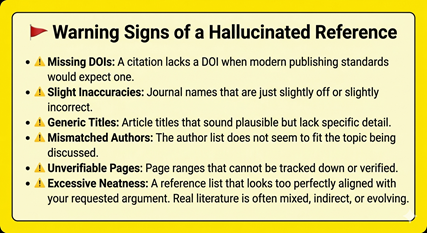
The risk is not limited to fabricated references. LLMs may provide real references with incorrect details, attach the wrong DOI, misstate findings, cite a paper for a claim it does not support or rely on outdated information. In CPD, an LLM may suggest a citation to support a needs assessment gap in imaging interpretation, but the article may address diagnostic accuracy rather than clinician performance, competence or practice variation. The citation may be real while still being wrong for the claim.
The primary implication is accountability. An LLM cannot be accountable for educational accuracy, clinical validity, accreditation compliance or learner trust. The human author, faculty member, reviewer, provider organization or education team remains responsible. LLMs may not have access to subscription literature, may not reflect recent evidence, may confuse similar articles and may summarize abstracts rather than full text. Some tools include retrieval, browsing or database integrations, but access does not equal accuracy. Current publishing guidance likewise assigns responsibility to human authors and requires review of AI-generated output. ⁵,⁶ Users still must verify that the source exists, is current and supports the specific claim.
A Practical AI-Reference Verification Workflow
Prompt for leads, not evidence. Ask the tool to identify possible peer-reviewed sources, clinical guidelines or official standards that may support the claim and to identify the evidence type and the specific claim each source may support. A stronger prompt should explicitly instruct the tool not to invent citations. That instruction can reduce risk, but neither the instruction nor the model’s assertion that it verified a source is proof. For example, a weak prompt asks, “Give me references on this topic.” A stronger prompt asks, “Identify possible peer-reviewed sources, clinical guidelines or official standards that may support this claim. Do not invent citations. For each source, state what claim it may support and identify whether it is a guideline, systematic review, original research, commentary or other source type.” Even then, the model’s claim that it has verified a source is not enough. Verification must occur through trusted databases, publisher sites, library resources or official sources.
| |
| |
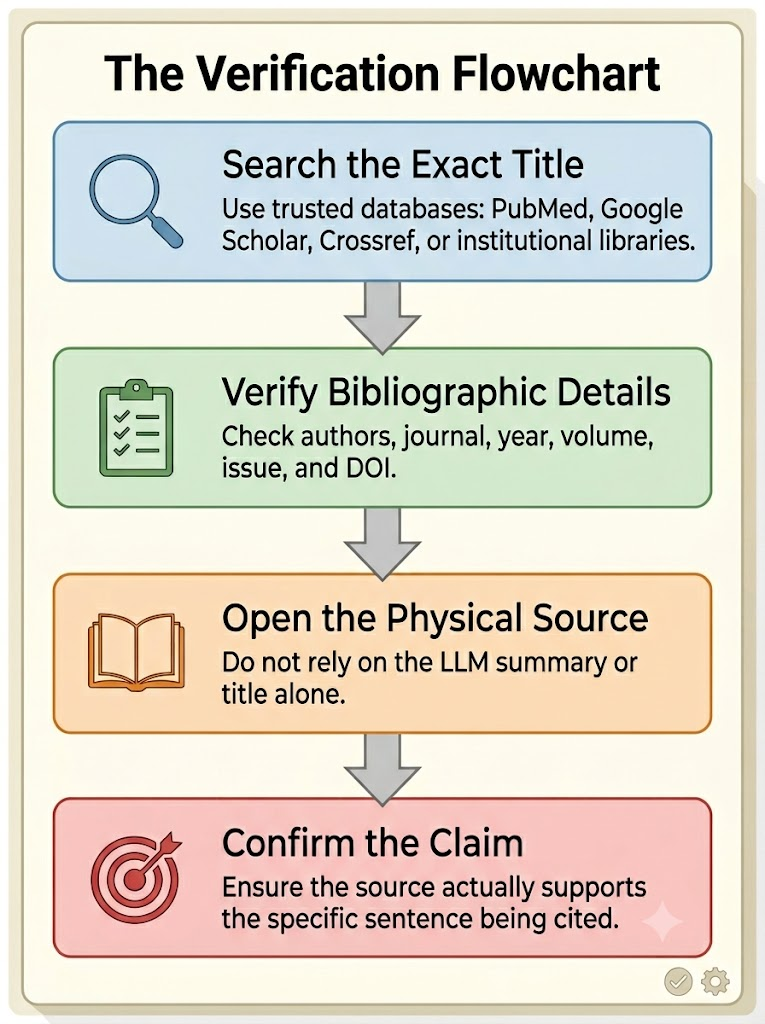 |
Verify independently. Use the workflow in Figure 2 for every AI-supplied reference. Confirm that the source exists, the bibliographic details match and the full source supports the specific claim. Check for corrections, retractions, expressions of concern or updates through appropriate tools.⁷-¹⁰
Organizations using AI in CPD content development should establish explicit expectations for reference handling. A practical standard might state: “References suggested by AI tools may be used only after independent verification. Verification must confirm that the source exists, the citation details are accurate, the source is current and credible and the source supports the associated claim.” Apply this standard to educational content, needs assessments, outcomes reports, grant proposals, assessment items, abstracts, articles and evidence-based marketing claims. Policies should separately address confidentiality, privacy and intellectual property safeguards.⁵,⁶
Conclusion
Reliable sourcing is a core competency in healthcare CPD. It requires selecting the right source for the right claim, assessing quality and relevance, checking for bias and currency and documenting the review process. LLMs can support this work, but they can also fabricate references, misrepresent real sources, overlook updates and present uncertainty as fact. The standard is straightforward: do not cite what you have not checked. AI-generated references should be treated as leads, not evidence. In CPD, credibility depends on whether a source is real, reliable, current, relevant and accurately tied to the claim it is being asked to support.
References
- Topaz M, Roguin N, Gupta P, Zhang Z, Peltonen LM. Fabricated citations: an audit across 2.5 million biomedical papers. Lancet. 2026;407(10541):1779-1781. doi:10.1016/S0140-6736(26)00603-3
- Accreditation Council for Continuing Medical Education. Standards for Integrity and Independence in Accredited Continuing Education. Published December 2, 2020. Accessed June 8, 2026. https://accme.org/resource/standards-for-integrity-and-independence-accredited-continuing-education-pdf/
- Walters WH, Wilder EI. Fabrication and errors in the bibliographic citations generated by ChatGPT. Sci Rep. 2023;13(1):14045. doi:10.1038/s41598-023-41032-5
- Barroga EF. Reference accuracy: authors', reviewers', editors', and publishers' contributions. J Korean Med Sci. 2014;29(12):1587-1589. doi:10.3346/jkms.2014.29.12.1587
- International Committee of Medical Journal Editors. Recommendations for the conduct, reporting, editing, and publication of scholarly work in medical journals. Updated January 2026. Accessed June 8, 2026. https://www.icmje.org/icmje-recommendations.pdf
- Elsevier. Generative AI policies for journals. Policy updated June 2026. Accessed June 8, 2026. https://www.elsevier.com/about/policies-and-standards/generative-ai-policies-for-journals
- Patrias K. Citing Medicine: The NLM Style Guide for Authors, Editors, and Publishers. 2nd ed. Wendling DL, ed. National Library of Medicine; 2007. Updated October 2, 2015. Accessed June 8, 2026. https://www.ncbi.nlm.nih.gov/books/NBK7256/
- National Library of Medicine. PubMed Single Citation Matcher. Accessed June 8, 2026. https://pubmed.ncbi.nlm.nih.gov/citmatch/
- Retraction Watch Database. Retraction Watch. Accessed June 8, 2026. https://retractiondatabase.org/
- GRADE Working Group. GRADE Book. Accessed June 8, 2026. https://book.gradepro.org/
Interested in this article? Join the discussion on the Alliance Community.
.png?ver=67o-anrkTKXxaKJ67I7fUA%3d%3d) Heather Ranels, MA, MS, CHCP, FACEHP, is a continuing professional development leader with more than 20 years of experience designing, implementing and evaluating accredited education for healthcare professionals. She has deep expertise in CME/CPD accreditation, adult learning, outcomes assessment, educational strategy and technology-enabled learning. Heather currently serves as Director of Medical Education for the Society of Cardiovascular Computed Tomography and is active in the Alliance for Continuing Education in the Health Professions, including service as Vice-Chair for the Almanac Editorial Board and CHCP certification and Fellow.
Heather Ranels, MA, MS, CHCP, FACEHP, is a continuing professional development leader with more than 20 years of experience designing, implementing and evaluating accredited education for healthcare professionals. She has deep expertise in CME/CPD accreditation, adult learning, outcomes assessment, educational strategy and technology-enabled learning. Heather currently serves as Director of Medical Education for the Society of Cardiovascular Computed Tomography and is active in the Alliance for Continuing Education in the Health Professions, including service as Vice-Chair for the Almanac Editorial Board and CHCP certification and Fellow.